Milo’s Story: Thriving with a KCNH1 Mutation
Milo’s mom, Amanda Schlegel, shared this story with us. Milo was born with a rare KCNH1 genetic mutation, and Amanda’s account of his journey, from “failure to thrive” to bat boy, cheering section, and soon-to-be kindergartner, speaks for itself. We are grateful to be part of it.
By Amanda Schlegel
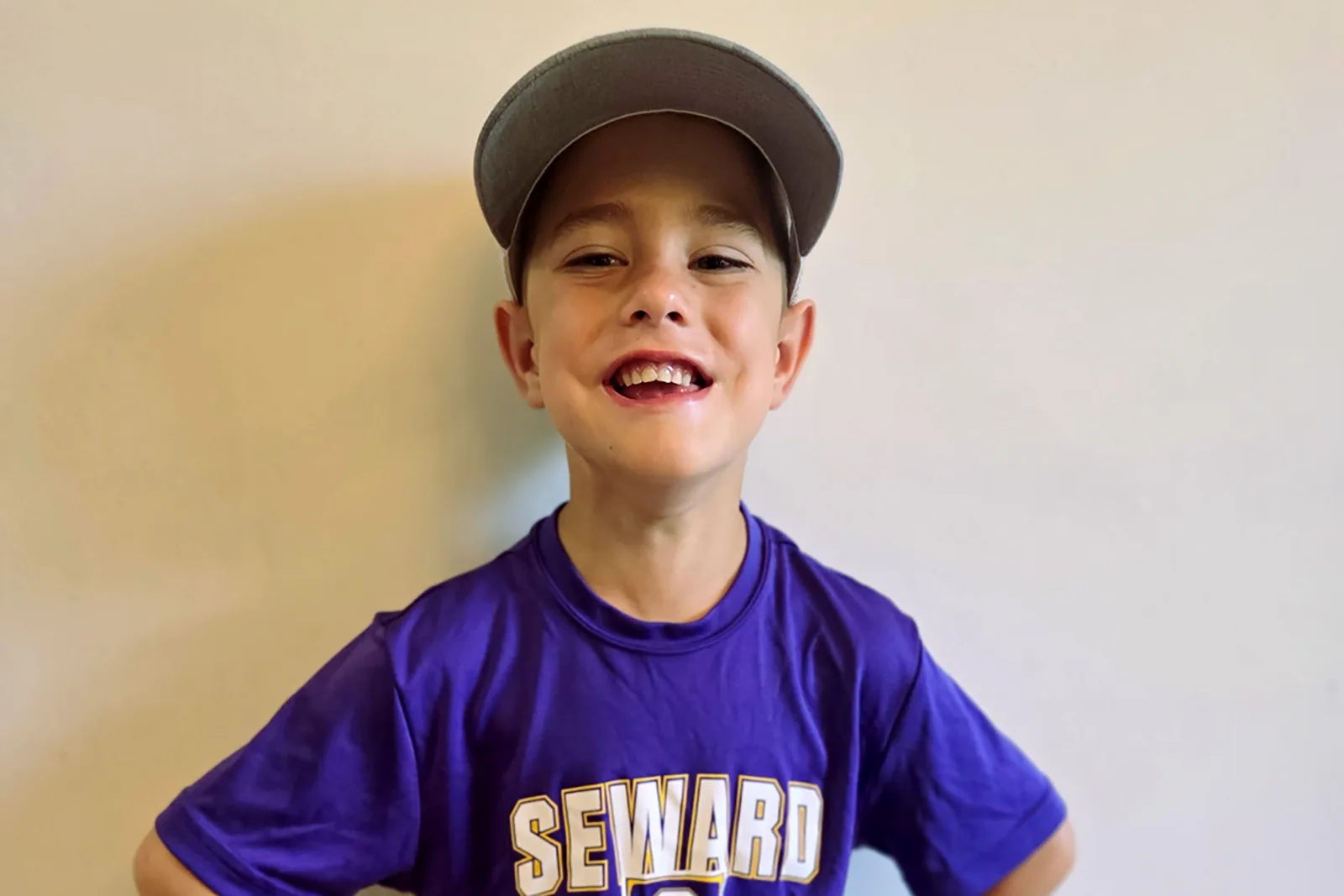
Hello! My name is Amanda Schlegel and my son, Milo, has a KCNH1 genetic mutation. Milo was born in April 2020, and we had no idea he had this mutation. He slept a LOT as a baby and was not very responsive or smiley (as most babies are). He would wake up very drowsy and slow, dropping his head and looking half asleep. It often took him a few minutes to fully wake up. By around 8-9 months he wasn’t able to sit up as he should and was labeled with “failure to thrive,” so we started investigating why. Long story short, we eventually learned of his mutation. We were given basically no direct resources or support other than it’s a “rare disease.” My internet searches felt futile. No discoveries were similar to Milo. He is on the more mild end of the impact of this mutation. I felt like we were basically all alone, pioneers, with most likely any similar cases not reported. I was almost offended our neurologist didn’t get more involved or seem to care, if he was essentially 1 in a million as they told us. But we just pushed on. He had horrible eczema and constipation around his first birthday. To combat that I sought the help of a nutrition expert and determined he needed to go gluten and egg free. Ever since, he’s had no problems there.
We focused a lot on what went into his body with a very strict diet, avoiding food dyes and limiting processed foods as well. I also focused on quality supplements: cod liver oil, a multivitamin, and a probiotic. Beyond that I am more than grateful God brought us to that nutrition counselor because she also connected me with another mom who utilized an amazing program called NACD (National Association for Child Development). “Brain trainers” is the easiest way for me to describe them. We knew Milo was behind developmentally and I wanted to do what I could to help him catch up. Beyond cognitive ability, he was also limited with his physical development because he had hypotonia. A local resource took us to get ankle/foot orthotics to support his incredibly loose ankles. But my gut thought was, why? As a trained strength and conditioning coach, it made no sense to me to do that. How would his ability to stabilize his joints improve with a band aid? NACD matched my thinking. When we got started it felt like a great fit right away. We were on the same page, a different one than standard therapists. We were working more from a function and root cause standpoint, rather than generic cover ups or blanket protocols. Through a variety of home exercises, my NACD coach and Developmentalist trained me to work with Milo, and he gained the strength and ability to walk, run, jump, climb, etc. with no AFOs over the first couple of years. The coaches continue to guide me through more than physical development. It is full-child. We work on language, speech, and importantly, cognitive development through a wide variety of tasks. It is an ongoing process. I never do it perfectly, and we continue to work on his overall growth and development. This fall I will be homeschooling him with their guidance as a kindergartner.
He is one of the most joyful, friendly little people you could ever meet. He is such a light to those around him, and he is often well known. Even at a 5-day family camp a state away from home last summer, nearly everyone knew who Milo was because he cheers and claps loudly during worship and encourages others, and he loves chatting with people (even when it doesn’t always make sense!). His two older siblings adore him, and their friends and teammates all know him well as he cheers them on from the sideline, and now from the dugout, as he worked himself into the bat boy position for 8U softball and 10U baseball. He does a great job, but he just gets distracted sometimes because he has to cheer on the last batter before running to the dugout with their bat.
I firmly believe the guidance from NACD has made a MASSIVE impact on his development, and I HIGHLY suggest checking them out for anyone at truly any level. They work with literally anyone of any ability or age. They never function off labels or testing, or put you in a box. Your child is your child, and they work with you where your child is to help them improve with whatever they need most. I wholeheartedly believe they can help anyone advance. The impact on Milo and our family is enormous. We are a very active family, and as Milo grows up he fits right in. He is able to join us for day-long softball tournaments; he attended half-day preschool for 2 years, leaving the staff disappointed he wasn’t coming back for Kindergarten. We can travel, participate in sports/activities, with no issues. Milo gets along great! He is dying to play his first T-Ball game soon. It has also been a joy and so heartwarming to see our coach and Developmentalist share in his victories and enjoy the process alongside us. It is hard to know exactly where Milo would be without NACD. It could be a very different story. That is why I’m so thankful NACD is part of his.
Curious whether NACD could help your child? Join our free Get Started program to learn how individualized programs work.