
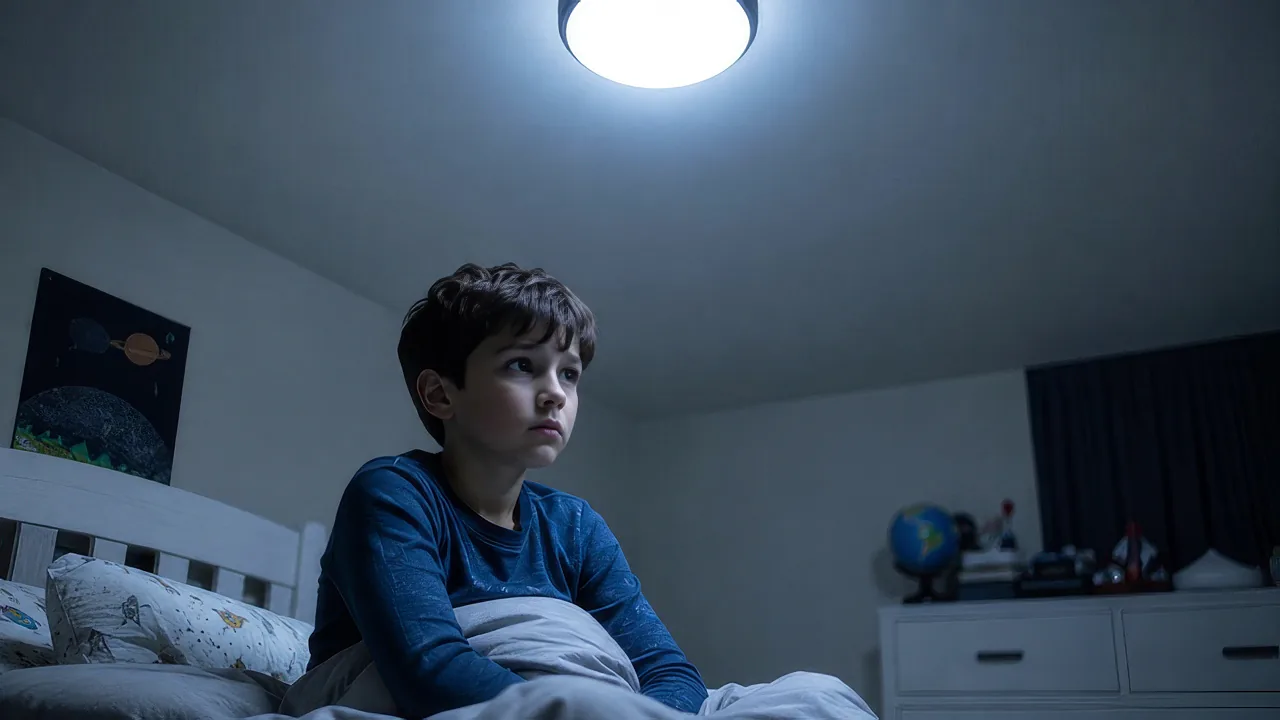
What LED Lights Are Doing to Your Child’s Sleep, Attention, and Behavior
Children are about twice as sensitive to evening light as the adults who bought the bulbs. The bulbs were sold on energy savings. The cost shows up in your child.
Over roughly a decade, the light in nearly every American home was replaced. Federal efficiency standards effectively ended the sale of standard incandescent bulbs in August 2023, and LEDs took over. The energy math was real. What was never on the ledger is what that light does inside a child’s nervous system in the hours before bed.
If your child fights sleep, wakes at night, or melts down every afternoon, the light in your family room is one of the few causes you can change this week for about forty dollars. Here is why it matters and exactly what to do.
Light is a hormonal signal, and children get twice the dose
Cells in the back of the eye do one job: they measure blue wavelength light and report the time of day to the brain. Lots of blue means noon. Amber light with little blue, like fire or an old incandescent filament, means evening. That signal controls melatonin, the hormone that tells every system in the body that night has begun.
White LEDs are built on a blue diode. Even a warm looking soft white bulb carries a spike of blue underneath the coating. Your eye reads cozy. Your brain’s clock reads midday.
Children take the hit far harder than adults. A child’s lens is optically clear, so more than 65 percent of blue light reaches the retina, compared with about 20 percent by the mid twenties. Their pupils are larger. The numbers that follow are why this article exists.
What the research found
- 2xUnder identical evening room light, melatonin was suppressed 88 percent in children versus 46 percent in adults. Children were roughly twice as sensitive (Higuchi et al., 2014).
- 70–99%Melatonin suppression in preschoolers from light in the hour before bed, at every intensity tested, including light dimmer than a normal hallway (CU Boulder, 2022).
- 50 minHow long melatonin stayed suppressed after lights out. In 7 of 10 children it had still not recovered to half of baseline (Akacem et al., 2018).
Two details deserve attention. In young children, dim light suppressed melatonin nearly as much as bright light, so turning the lights down does not solve it. And the suppression outlasts the light, so a perfect bedtime routine cannot undo the hour that came before it.
Why this lands hardest on the hyperactive child
Sleep and attention are not loosely related. They are causally linked, and the link has been tested. In a randomized BMJ trial of 244 children with ADHD, families received nothing but two consultations on sleep and a follow up call. ADHD symptom severity improved at three and six months, moderate to severe sleep problems dropped from 56 percent to 30 percent, and a third to half of the benefit ran specifically through better sleep. For scale, the improvement in ADHD symptoms was roughly a third to half the size of the effect stimulant medications typically produce in clinical trials. Two conversations about sleep, no prescription, no side effects, and a meaningful fraction of what the medication delivers. A separate crossover study restricted adolescents with ADHD to 6.5 hours of sleep for a week, and parents reported more inattention and oppositional behavior. Same kids, different sleep.
The chain is short. Evening light suppresses melatonin. Children are twice as sensitive. Suppressed melatonin delays and shortens sleep. Short sleep worsens attention and regulation, most in the children with the least margin. LEDs do not cause ADHD, but for a child already working with a narrow margin, the family room lighting taxes it every single night.
There is a second issue specific to LEDs: flicker. Cheap LED drivers pulse the light 120 times per second. You cannot see it, but the visual system processes it. The engineering body IEEE published a formal standard on the health risks, listing headaches, eyestrain, reduced task performance, distraction, and increased autistic behaviors in children. Flicker is a solved problem that costs a little more per bulb, and nothing on the package tells you which bulbs have it.
Yes, light is an endocrine disruptor
You have probably heard the term endocrine disruptor applied to chemicals like BPA, things that get into the body and interfere with hormones. Wrong evening light does the same thing to a child’s hormones, it just gets in through the eyes instead of the mouth. Nothing leaches out of the bulb. The light itself is the exposure: it enters the eye, shuts down melatonin, and disturbs the timing that other hormones, like the stress hormone cortisol, are built around. That is why researchers formally classify artificial light at night as an environmental endocrine disruptor.
This is taken seriously at the highest levels. The World Health Organization’s cancer agency rates night shift work, which scrambles the body’s light and dark schedule, as probably carcinogenic to humans. France’s national health agency officially recommends warm bulbs below 3000K at home and specifically warns against children’s evening exposure to blue rich LED light. American parents have simply never been told.
For perspective: the famous Southampton food dye trial found that artificial colors increased hyperactivity in children, and that finding changed how a generation of parents shops. The measured effect was small. Meanwhile the light fixture over the dinner table is cutting a preschooler’s primary circadian hormone by 70 to 99 percent, three hours a night, every night. We read every ingredient label and have never once audited what falls on our children’s eyes.
The most powerful fix is free: real sunlight, morning and evening
Before you buy anything, understand that the bulbs are only half the problem. The other half is that our children get too little of the light they were built for. The body does not judge evening light in isolation. It judges contrast. A child who gets bright natural light all day is far more resistant to evening disruption than a child who went from a dim classroom to a dim house to a bright screen.
The gap is enormous. Indoor lighting measures a few hundred lux. Outside, even under full cloud cover or tree shade, light measures in the thousands to tens of thousands. A window cuts most of it. There is no bulb, no app, and no supplement that substitutes for going outside.
Morning light is the anchor, and it pays out all day. Within an hour of waking, get your child outside for 10 to 30 minutes. Breakfast on the porch, walking to the bus stop instead of driving, ten minutes in the yard before school. Morning light sets the body clock, and nearly everything a parent cares about hangs off that clock. Tonight’s melatonin release is scheduled by this morning’s light, so kids fall asleep easier and sleep deeper. Morning light triggers the healthy morning rise in cortisol that produces natural alertness, which means easier wake ups and a sharper first half of the school day instead of a foggy one. Bright daylight also drives serotonin activity, the brain chemistry behind steady mood, which is one reason mood dips in dark winters and why light is used to treat it. Appetite, energy, and emotional regulation all run on the same clock. One habit, ten minutes, and it compounds every day.
Evening light closes the day and protects the eyes. The low, amber light near sunset is the signal every generation before ours ended the day with, and twenty minutes outside after dinner tells the body the day is wrapping up. It doubles as movement, which itself deepens sleep, and as unstructured time together, which most families are short on. It also carries a benefit most parents have never heard: outdoor daylight is the best proven protection against childhood nearsightedness, which now affects nearly half of kids in some parts of the world. Adding 40 to 80 minutes of outdoor time per school day cut new cases of myopia by 25 to 50 percent in randomized school trials. The same daily walk that settles bedtime is protecting your child’s vision.
Pull natural light into the places your family actually spends the day. At home, open the blinds fully every morning, move homework and play toward windows, and eat breakfast in the brightest spot in the house. At school, ask whether your child can be seated near a window, and advocate for outdoor recess staying outdoors, since recess is many children’s only real light exposure of the day. At the office, the same biology applies to you: take a call walking outside, eat lunch outdoors, claim the desk near the window. Parents who fix their own light sleep better, and the whole household’s rhythm improves together.
Then fix the bulbs
- Start with the two rooms that matter most: wherever the family sits after dinner, and your child’s bedroom. That is usually six to ten bulbs. Replace the rest of the house gradually as bulbs burn out.
- After dinner, turn off the ceiling lights. Overhead light is the geometry of noon. Use two or three lamps at or below eye level instead. This costs nothing.
- Buy by the numbers on the box: 2700K or lower (2200K amber for the last hour before bed), CRI 90 or higher, labeled flicker free, and dimmable on a compatible dimmer.
- Test for flicker yourself. Point your phone’s slow motion camera at any lit bulb for two seconds. Rolling dark bands mean flicker. A steady image means a decent driver. Test what you already own before buying anything.
- Use up any incandescent bulbs you still have in the evening lamps. They no longer sell for general lighting in the US, but the ones in your garage are the best evening light in the house. Note that Edison style filament bulbs on store shelves are LEDs in costume, so test them like any other.
- Night lights should be red or amber and near the floor. Cover the blue standby lights on electronics in the bedroom. And be honest about screens: a tablet at close range is a bigger blue dose than any ceiling fixture. Warm mode on, and off before wind down begins.
What this means for your family
LEDs solved a real energy problem. Nobody was measuring what they did to children, so that never entered the decision to put them in every home in the country. The savings are real and they are small. The cost lands in places no one tracked: how long it takes your child to fall asleep, how the afternoon goes, how much patience your child has left by dinner.
Changing your lighting will not resolve a significant attention or behavior problem by itself, and no one should promise you otherwise. What it does is remove one obstacle that has been working against your child every evening, and it is one of the few obstacles you can remove yourself this week without a waiting list or a prescription. NACD has spent more than 47 years working with families on the daily inputs at home, because that is where change actually happens. Light is one of the most overlooked inputs there is.
Start tonight
Tonight: stand in the room where your family spends the hour before bed and pay attention to the light instead of through it. Run the slow motion camera test on your bulbs.
Tomorrow morning: ten minutes outside with your child, whatever the weather is doing. This is the single highest value step and it costs nothing.
This weekend: replace the bulbs in your main living area and your child’s bedroom, and switch to lamps after dinner.
Keep score: log time to fall asleep and afternoon behavior for one week before the changes and two weeks after. Sleep usually moves first, within about ten days. Behavior follows sleep.
If sleep does not improve, or your child snores, mouth breathes at night, or wakes exhausted regardless of hours in bed, that pattern deserves a medical evaluation, and it is also exactly the kind of whole picture we look at in an NACD evaluation. Sleep, environment, and development are one system, and we treat them that way.
Start Your Free Get Started ProgramKey sources
- Higuchi S, et al. Influence of light at night on melatonin suppression in children. J Clin Endocrinol Metab, 2014.
- Akacem LD, Wright KP, LeBourgeois MK. Sensitivity of the circadian system to evening bright light in preschool age children. Physiological Reports, 2018.
- Hartstein LE, et al. Evening light and melatonin suppression in preschoolers. University of Colorado Boulder, 2022.
- Hiscock H, et al. Behavioural sleep intervention in children with ADHD: randomised controlled trial. BMJ, 2015.
- Becker SP, et al. Shortened sleep duration causes sleepiness, inattention, and oppositionality in adolescents with ADHD. J Am Acad Child Adolesc Psychiatry, 2019.
- IEEE Standard 1789-2015 on LED flicker and health risks, summarized at FlickerSense.
- ANSES. LEDs: recommendations for limiting exposure to blue light. 2019.
- IARC Monographs Volume 124. Carcinogenicity of night shift work. 2019.
- Russart KLG, Nelson RJ. Light at night as an environmental endocrine disruptor. Physiology and Behavior, 2018.
- McCann D, et al. Food additives and hyperactive behaviour in children (Southampton study). The Lancet, 2007.
- Wu PC, et al. Myopia prevention and outdoor light intensity: cluster randomized trial. Ophthalmology, 2018.
- He X, et al. Time outdoors in reducing myopia: cluster randomized trial. Ophthalmology, 2022.
- US Department of Energy. Lightbulb efficiency standards.
Laird Doman is part of the leadership of the National Association for Child Development, where he works on how families translate developmental science into what actually happens at home. NACD has worked with families worldwide since 1979.