The Dinner Table Is the Most Underestimated Classroom in Your Home
by Laird Doman
I’ll be honest with you. Some nights, dinner at our house looks nothing like what I know it should be.
My daughter Arielle is nine. My son Lachlan just turned six. By the time we all sit down together, everyone is carrying the weight of the day. Lachlan is often a little hungry and short-fused by dinnertime, which any parent of a six-year-old will recognize instantly. Ari has her own version of the end-of-day wind-down. My wife Sadie and I are fielding the usual logistics. And somewhere in the middle of all of it, there’s a screen nearby with its particular pull, always available, always easier than the work of actual conversation.
I know this because I live it. And I know it because at NACD, we have spent more than four decades studying exactly what happens to children’s brains when the people around them talk to them, and what happens when they don’t.
What the Research Has Been Telling Us for Years
My father, Bob Doman, has written extensively about the family meal as one of the most important developmental events in a child’s day. In his piece The Most Important Meal of the Day Is Not Breakfast — It’s the Meal(s) the Family Has Together, he makes a case that most parents don’t fully appreciate: the dinner table isn’t just where you eat. It’s where your child’s brain learns to process language, build memory, attend to others, and begin to understand the structure of the world they live in.
The mechanism behind this is auditory processing, which is the brain’s ability to take in spoken language, hold it, interpret it, and respond to it. As Lori Eby Riggs has written in Auditory Processing — What Is It?, auditory processing underlies virtually everything we associate with a child’s cognitive function: attention span, language development, the ability to think in words, and the complexity of their reasoning. And what builds auditory processing more than anything else? Targeted language input. Real conversation. The kind that happens when a parent asks a child something genuine, listens to the answer, and pushes a little further.
There’s a line from that article on family meals that has stuck with me: “No one is better suited to this job than the people who know the child best; and no time may be better suited to this development than the family meal.”
That’s not a soft sentiment. That’s the neurodevelopmental science of 45 years of work with tens of thousands of families, distilled into one sentence.
And yet most family dinners don’t look like that. Most of them are one-word answers and glowing screens.
The Challenges Are Real
When I talk about the dinner table as a developmental opportunity, I’m not describing a magazine photograph of a family glowing with perfect conversation over a home-cooked meal. I’m describing something that requires real effort, most nights, against real resistance.
Here’s what I run into constantly, even knowing everything I know:
Devices
The pull is relentless. New studies are coming out by the day documenting how harmful screens are on developing brains, and yet the phone is still there, the tablet is still there, and children have absorbed from the culture around them that screens are the default way to fill any available moment. We have a no-devices rule at our dinner table, but that rule requires active enforcement every single time. It doesn’t just happen.
Exhaustion
By dinner, everyone is tired. Lachlan at six is a bright, curious kid, but by the end of the day he’s hungry and has run out of patience for things that don’t immediately interest him. Ari at nine wants to talk, but only about the specific things on her mind at that moment, and if the conversation doesn’t head there quickly, she checks out. Sadie and I are not exempt from this either. The desire to just sit quietly and not manage anything for ten minutes is something every parent understands.
The question problem
This is the one that took me the longest to name. Even when we manage to get everyone to the table without a device, even when the kids are present and willing, I often find myself asking the same questions: “How was your day? What did you do? What did you learn?” And getting the answers those questions deserve: “Fine. Nothing. I don’t know.” The questions aren’t bad. They’re just not good enough. They don’t open anything. They invite a one-word exit and everyone moves on.
This is where, in our work at NACD, we’ve always understood something important: the quality of input determines the quality of output. We say this constantly in the context of neurodevelopmental programs — the specificity of what you give a child’s brain matters enormously. It turns out this principle applies equally to conversation.
What Happens When You Get It Right
I want to tell you about something that changed at our dinner table, because it was Ari and Lachlan who taught it to me rather than the other way around.
We started asking about family history. Not heavily, not as a formal exercise. Just questions like: “What do you think Dad’s childhood was like? What do you think Grandpa did when he was your age? What stories do you think our family has that nobody has written down?”
What happened surprised me. Lachlan, who is full of ideas and moves quickly from one thought to the next, got completely still and started asking questions I didn’t expect him to have. Ari, who I sometimes struggle to keep at the table, leaned in. They wanted to know. They wanted to know us — the people who came before them, the choices that were made, the world that existed before they arrived in it.
What I also realized is that the questions didn’t just flow one direction. Ari started asking me things I hadn’t thought about in years. Lachlan wanted to know what my grandfather was like. The conversation became something genuinely mutual — kids asking parents, parents asking kids, everyone at the table actually curious about what the other person would say. That’s what good family history questions do. They make the parents as interesting as the children, and they give kids the feeling that their questions matter just as much as ours.
The family history conversation opened something that “How was your day?” never could. It gave them a sense of place in something larger than themselves. It built what NACD has long recognized as one of the most important things we can give a child: identity. A felt sense of who they are and where they come from.
Neurologically, what was happening is exactly what my father describes in his work on parents as the primary architects of their children’s development. See Where Have All the Mothers Gone? and
Parents Are the Solution for the deeper framework. Autobiographical memory, sequential narrative, perspective-taking, the ability to hold a multi-part story in working memory and reason about it — these are all cognitive skills, and dinner conversation is one of the richest environments for developing all of them simultaneously.
The difference wasn’t the effort we put in. It was the quality of the question we started with.
What a Good Question Actually Does
At NACD, we think about intervention specificity constantly. The whole framework of Targeted Developmental Intervention — the approach that has guided our work for decades — is built on the idea that the more targeted and specific the input, the more targeted and effective the result. A vague program produces vague results. A precisely designed program, delivered consistently, produces real change.
The same logic applies to conversation.
A vague question like “How was school?” produces a vague answer. It asks nothing specific of a child’s brain. There’s no cognitive demand. They can answer it honestly and completely with a single syllable and move on.
A good question is different. A good question requires a child to retrieve a memory, construct a narrative, evaluate a perspective, or make a decision under constraints. “If you could change one rule in our house, what would it be and why?” asks Lachlan to do half a dozen cognitive operations before he opens his mouth. “Tell me about a time when you felt really proud of yourself — not because anyone told you to be, but because you just knew” asks Ari to access autobiographical memory, evaluate an emotional experience, and find the language to describe an internal state. These are not trivial tasks. These are exactly the kinds of tasks that build auditory processing, working memory, perspective-taking, and executive function — the foundational capacities that all of NACD’s work is built around.
For more on why these cognitive foundations matter so profoundly, read Processing Power: What Every Parent Needs to Know.
Why We Built an App
I’ll be direct about this, because I think the honesty matters.
We didn’t build Family Conversations because we thought parents didn’t know dinner conversation mattered. Most parents, at some level, already know. We built it because knowing isn’t enough. Knowing doesn’t solve the problem of sitting down at the table at 6:30pm, exhausted, with a six-year-old who has run out of patience and a nine-year-old who wants to talk about something specific you haven’t thought to ask about — and needing, in that moment, the right question.
The problem isn’t intention. The problem is the gap between intention and execution, in the moment when it’s hardest.
We also know, from 45 years of working with families, that parents are the most powerful force in a child’s development when they’re equipped with the right approach, the right tools, the right questions. That’s the entire NACD model — we don’t work with children directly. We train and equip the people who know those children best. As my father has written in All Our Mothers Need to Be 10s (and Our Dads Too!), the parent’s function is the first variable we look at — because the parent is the program.
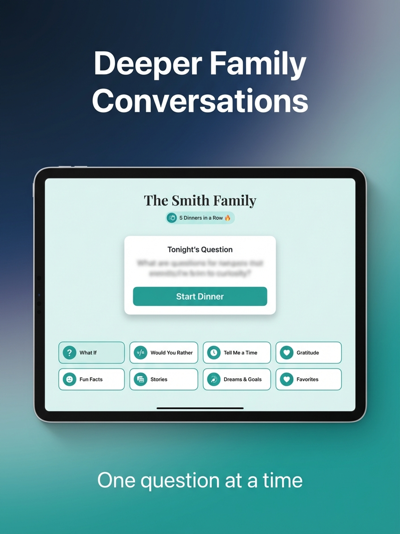
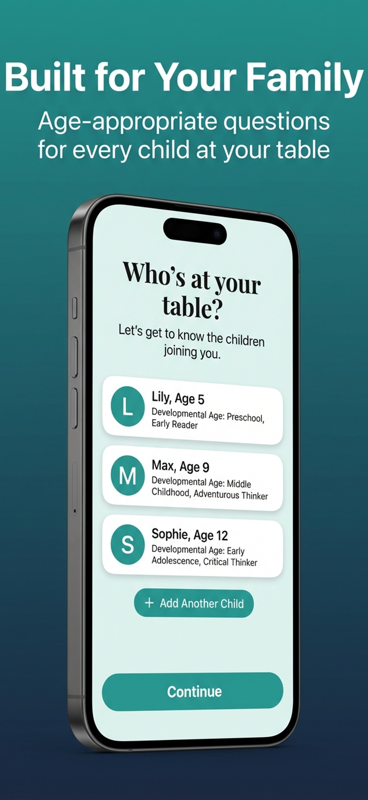
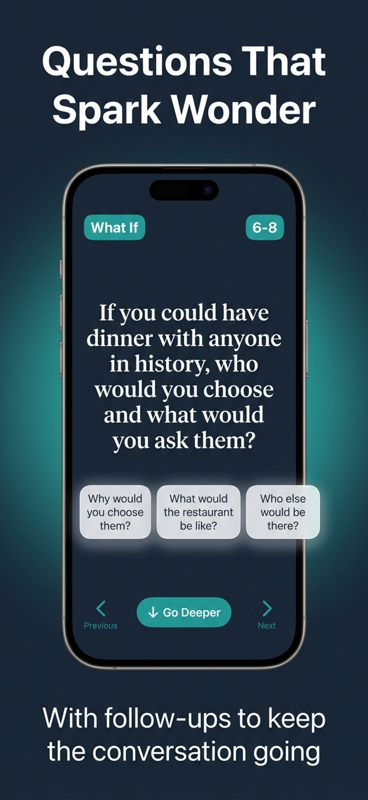
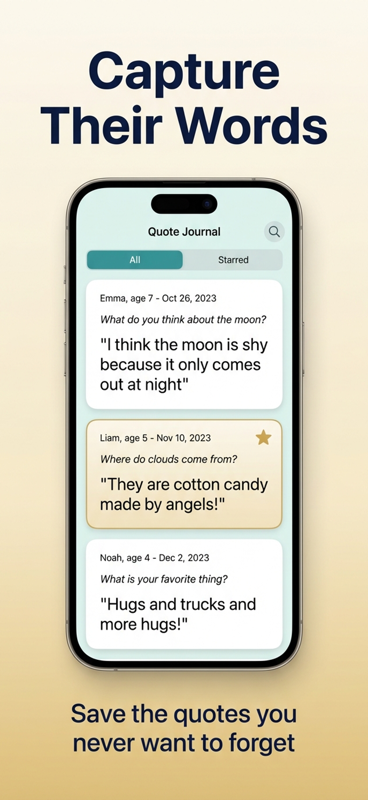
Family Conversations is built on that same principle. Every question in the app is designed around a real cognitive or emotional skill: perspective-taking, moral reasoning, autobiographical memory, creative inference, values clarification. Every card includes follow-up prompts, so when the conversation stalls (and it will stall), you have somewhere to go. Each question is calibrated to your child’s age and developmental level. There’s a “Go Deeper” option for when your family is ready for more. And there’s a Quote Journal, because some of what your children say at the dinner table deserves to be kept.
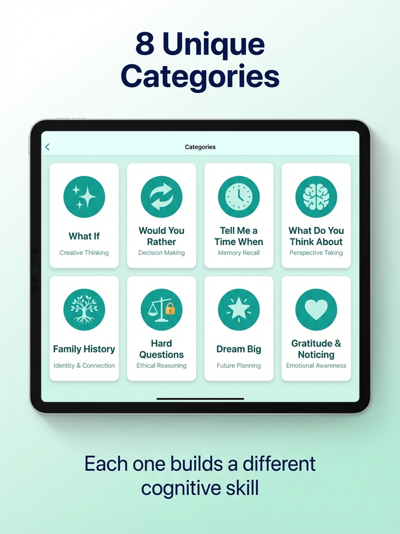
One thing we were intentional about: the app is designed so the phone doesn’t have to be out at all. Family Conversations works on Apple Watch, so you can glance at a question on your wrist and leave your phone in the other room where it belongs. It also works beautifully on iPad, which is a natural fit for families who want something propped up at the table. Pull up a question, start the conversation, then set it aside and be present. That’s the whole idea.
The Table Is Where Your Family Lives
I think about my grandfather, Dr. Robert J. Doman, and the work he did as a physiatrist pioneering the field of brain injury rehabilitation. I think about my father, building on that work for half a century, developing the neurodevelopmental framework that has changed the lives of hundreds of thousands of families. And I think about what it means to be the third generation of this family devoted to the idea that children have unlimited potential — and that the people most positioned to unlock it are the ones sitting across from them at the dinner table every night.
Ronald Reagan once said, “All great change in America starts at the dinner table.” He was talking about politics. But he was right about something deeper: the dinner table is where families become families. It’s where children learn who they are, where they come from, what they believe, how to think, how to listen, how to disagree with someone they love, and how to tell a story that matters.
Put the devices away. Ask a better question. See what happens.
And if you need a little help with the question, we built something for that.
Laird Doman is the third generation of his family devoted to the neurodevelopmental well-being of children worldwide. He lives with his wife Sadie and their children Arielle and Lachlan.
Related Reading at NACD
- The Most Important Meal of the Day Is Not Breakfast
- Auditory Processing — What Is It?
- Processing Power: What Every Parent Needs to Know
- Where Have All the Mothers Gone?
- Parents Are the Solution
- All Our Mothers Need to Be 10s (and Our Dads Too!)
- Confidence Through Chores